

A Design System Proven to Scale
Design ops, team enablement and design system strategy to scale people, processes, and products.
Client
Major Canadian Airline
Industry
Aviation
Role
Design Lead & Strategist
Category
Client Enablement & Delivery
Duration
8 months, 2024
THE CLIENT
One of Canada's largest airline in the market providing comprehensive air transportation networks, serving over 51M passengers.
SOLUTIONS
Service Design & Design Operations
Design System Product Roadmap
Scaling Design Systems for Consistency (Tokens, Theming, Cascading Tiers)
Governance Frameworks & Guidelines
Heuristic Evaluation, Baseline Metrics, User Research
Collaborative Workshops
BUSINESS GOALS
Create a unified and accessible design system, demonstrating its use and value over time.
Speed to value
Reduce design/development time and effort to enable teams to go to market faster.
Unified experience
Create consistent digital products through end-to-end adoption from design to code.
Accessibility
Increase accessibility standards and compliance needs across consumer-facing digital experiences.
Pre-existing state of component libraries used across the digital team.
THE CHALLENGE
The airline’s existing design system, governance, and workflows are underperforming relative to the evolving needs of the organization.
This has left the business without means to cost-effectively design and maintain digital assets, leading to limitations in identifying and responding to customer’s needs.
Disconnected internal workflows + legacy systems + inconsistent design assets = Broken customer experiences
Over 4+ disparate
Component libraries with duplicates, snowflakes, and broken components, slowing onboarding.
23 non-compliant
Components that failed WCAG AA and/or AAA compliance, a requirement for federal entities.
Design/code
No true owners across the 2 disciplines, lack of standardized practices, with major silos.
THE VISION
Create a cohesive digital and physical experience for airline customers with a unified design system and shared design language, accelerating product development and evolution.
New state of component library structure across the digital team.
KPIs + OBJECTIVES
⬇️ Decrease Cycle Times
Reduction in total cycle time for product teams after adopting Tarmac
Time spent on backlog & QA
⬆️ Increase Design to Code Accuracy
Reduction of # defects will after adopting Tarmac
Increased knowledge of governance processes
⬇️ Decrease Overproduction
Reduction of a11y bugs/fixes
Speed and clarity of onboarding
Standardizing how components, styles, and formatting are used across Tarmac features.
DESIGN PRINCIPLES
💬 Shared Design Language
Consistency & Standardization
Creating cohesion and alignment for how we approach design and experiences.
🌱 Made to Scale
Scalability & Evolution
Based on Atomic design, patterns and layouts are thoughtful and ensure longevity.
🎯 Clear Ownership
Governance & Process
Clear roles and responsibilities, direct and peripheral team structures.
👁️🗨️ Bake In Inclusivity
Accessibility
Atoms are accessible at their core, up-skill and train library users.
🌟 One Source of Truth
Version Control & Maintenance
Standardizing hygiene and upkeep, develop clear protocols.
💪 Centered Around All Users
User-Centric
Understand we’re not only designing for consumers, but for ourselves.
STRATEGIC PARTNERSHIPS
As consultants, we don’t just advise –we embed. Through staff augmentation, we worked with our client to implement research-driven processes, establish strong foundations, and co-create a design system that integrates into their daily workflows, ensuring lasting impact.
1/ UNIFY
Activities
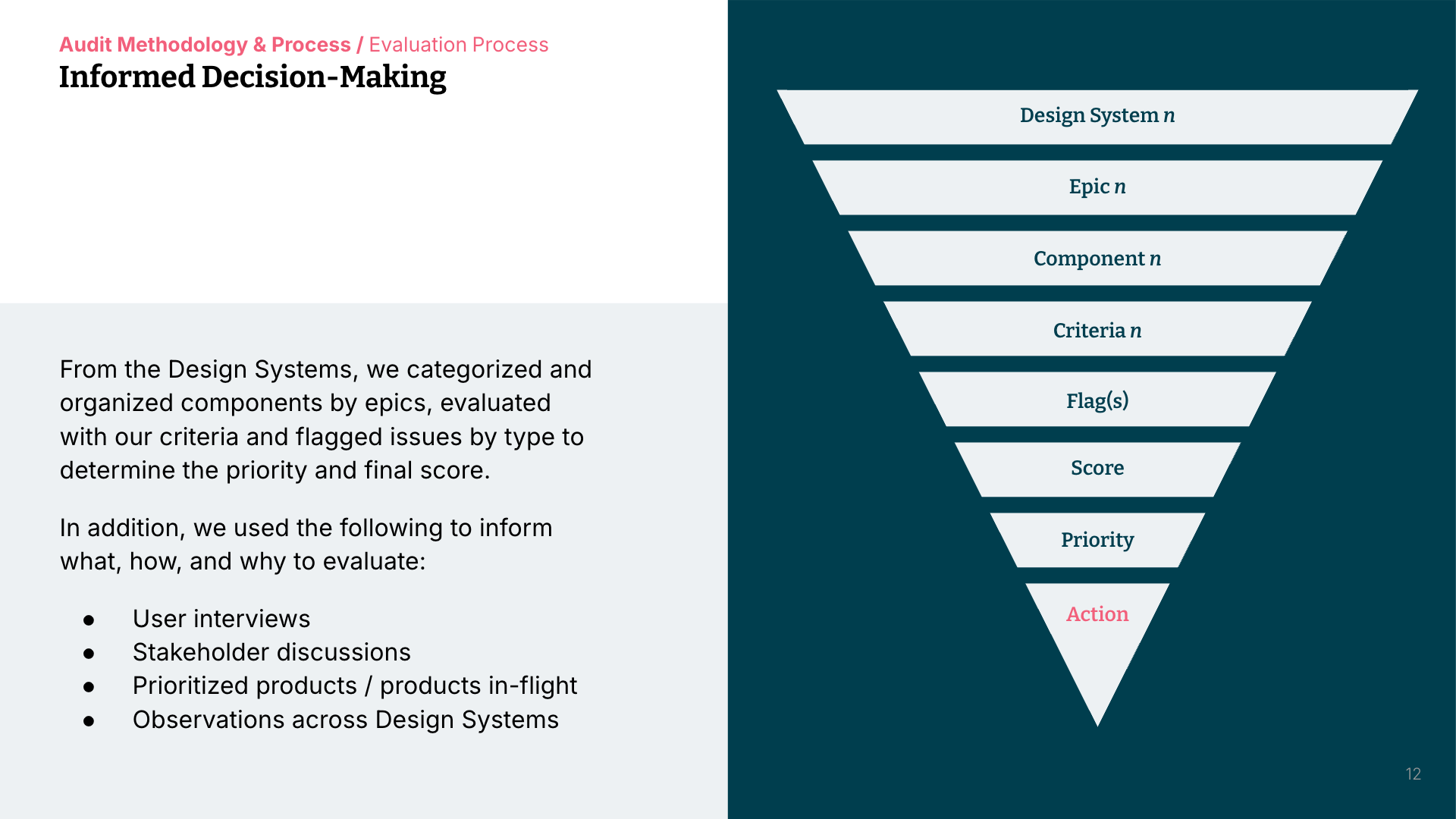
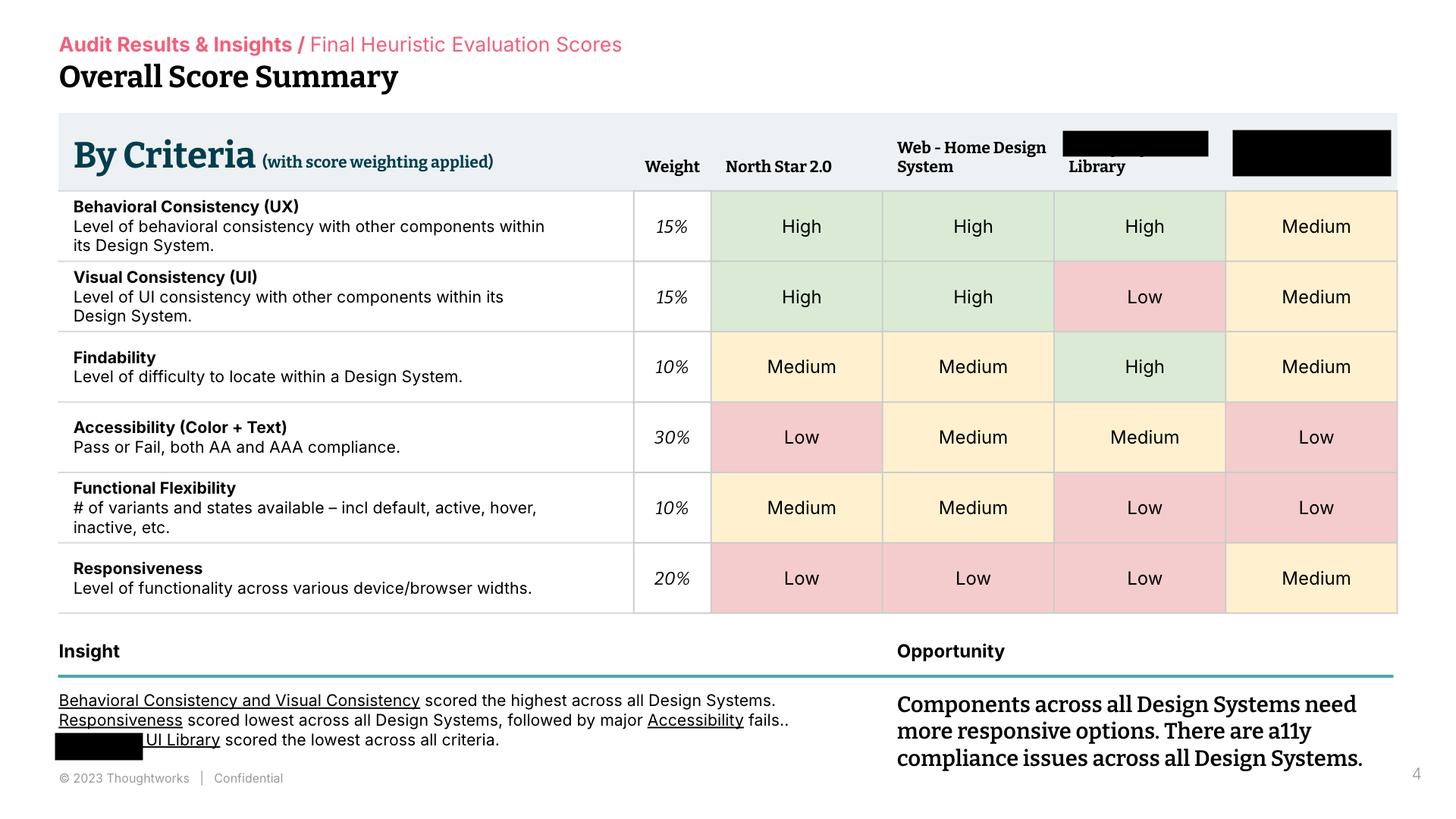
Comprehensive usability audit w/ weighted criteria scored
Vision-setting + alignment workshops x3
Unify teams and all components to assess the landscape with heuristic evaluation and auditing.


2/ UNCOVER
Activities
10 qualitative interviews w/ users
5 qualitative interviews w/ key stakeholders
Surveys to set baseline metrics
Workflow shadowing
Uncover user archetypes and sentiments to identify behaviours, gaps, needs, and hopes.


We discovered the most painful themes related to people and processes, less so the product.
Unclear standards for vetting components
⭐ Opportunity
Pilot test a decision tree that act as a guide for DS owners and users to determine when, where, and why a component/change should be made in the DS.
Lack of workflows and guidelines
⭐ Opportunity
Facilitate a ways of working workshop to align DS teams on roles and responsibilities, establishing workflows that are appropriate to individual’s capacity, experience, and skillset.
3/ PILOT
Activities
Revised Figma component library
Usability testing w/ SEQ scores
Pilot w/ a small set of DS users and owners in a controlled setting
Embedded expertise on client teams over 3+ months, working on real projects
Refine foundations in Figma, molecules / organisms / templates, variables, and tokens. Build familiarity with the new DS and governance processes, re-assess its usage and usability.


RESULTS
1. Bake in a11y
Providing actionable guidelines and built-in apps for designers to ensure accessible standards.
2. Create a Shared Language
Standardizing how to use patterns, components, and Figma best practices. From tokenization mapping to using variables and theming.
3. Define Clear Ownership
Pilot iteration of our governance workflows tested within a 3 month period with the airline’s internal product and design teams. We defined specific roles and responsibilities for how, when, and why teams would engage.
OUTCOMES
Our augmented teams were able to achieve internal team adoption and secure an extended contract to expand our scope and continue efforts.
“We’re doing something that’s never been done before here – creating a unified design culture. This design system is a vehicle to collaborate, enabling us to do so much more.”
“Your ability to pivot to deliver the MOST value on our current engagement, while still training/coaching the client team for long-term success is exemplary. ”
“Not only did you deliver a polished foundation for the design system and evangelize our methods, you also helped build relationships and create buy-in for the work we are doing across the team.”


